|
 |
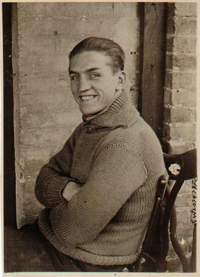
Georges Carpentier
By: "BC" Bob Witt
| On July
2,1921, at Boyles Thirty Acres, Jersey City, New Jersey, there
were several landmark events that occurred, the event the
world heavy weight title fight between champion Jack
Dempsey and the challenger Frenchman Georges Carpentier.
One landmark was that it was the first fight to gross
more than $1 million at the gate. This fact was very
important to one, Tex Rickard, the promoter; but the
landmark that was to leave a lasting imprint on society
as a whole, hence forth, was that the first radio broadcast of a fight was described by Major Andrew White and J.O. Smith. The
equipment used to broadcast the fight belonged to the United States Navy, and
required special authorization to be moved to the boxing site.
|
 |
This authorization was finally granted by one Franklin
Delano Roosevelt, then a Naval officer, who was, of course, to go
on to bigger things himself, just as boxing broadcasts would. The fight itself must have been rather
disappointing to the 80,000 in attendance, as well as the radio audience, as Georges Carpentier broke his thumb in the second round, and was hammered to
the canvas by the fury of Jack Dempsey's attack in the fourth round. This
loss was certainly not a defining moment in the career of Georges
Carpentier, as the "Pride of Paris" was the darling of France during his heyday, and
was as celebrated as the most famous movie star or war hero. The son of a
miner,
Carpentier was born in 1894 in Len's France. He started boxing as a
fly weight and during his career he progressed all the way to the heavy
weight division. Winning the French National Light Weight title when only 15
years old.
 |
|
By his 18th birthday, he was the European welter weight
champion. Then after more than 30 bouts, Carpentier stepped up to the heavy weight division, and KO'd British champion "Bombardier" Billy Wells in the
1st round. This match took place in London December 8,1913. Carpentier,
now European Heavy Weight Champion, proceeded thru 8 more contests. One
was in a losing effort to famous black heavy weight, Joe Jeanette. Before
winning a match from American Ed "Gunboat" Smith on a disqualification,
Carpentier was proclaimed "White Heavy Weight Champion of the
World". This, of
course, was a phony title as the real champion was the black American Jack
Johnson. The world itself was about to undergo a great upheaval that would forever
change not only national boundaries but the social, moral, economic,
artistic, scientific fabric of the entire planet. |
WWI of course was like
nothing here to fore seen by mankind, Georges Carpentier's life was changed as was
the life of millions. The son of a Len's miner joined the French Air
Force, served his country with such distinction that he was awarded his
nation's
highest honor, the "Croix de Guerre, and the "Medaille Militaire". Carpentier was not to return to the ring until 1917. He was still
only 23 years old. Carpentier continued his career in Europe until 1920 when
he crossed the Atlantic to fight for the Light Heavy Weight Championship
of the world. There he wrested the title from "Battling" Levinsky, and was impressive enough to set in motion the machinery that would bring
about the previously described spectacle that would occur in Jersey City in
1921 with the Heavy Weight Champion Jack Dempsey.
| The following year, 1922, Carpentier successfully defended his Light
Heavy Weight title in London against Ted "Kid" Lewis with a controversial
1st round KO. Just four months after the Lewis win, Carpentier fought the
little known Senegalese boxer "Battling" Siki, in
Paris. This was supposed
to be an easy match; however, that was not the case. Siki hammered Carpentier
until the 6th round when Carpentier's corner "threw in the towel". The
referee, apparently out of loyalty to the national hero, ignored the towel and disqualified Siki for allegedly tripping Carpentier. The crowd was fortunately not able to stomach such injustice and caused such a
commotion that the decision was reversed. Carpentier never regained his
previous form. In 1924 and 1926, he fought in the USA losing to both Gene Tunney and
Tommy Loughran. |
 |
Of course, he did win 6 more fights during his career but
to much
lesser competition. Georges Carpentier was one of boxing's
innovators. Like many others, he lost his best years to a war. He gave the French
nation a boxing legacy. His elegant charm outside the ring was also a memory
maker. He was one of boxing's historical giants.
Photos Courtesy of Antiquities
of the Prize Ring |
|
|
