|
 |
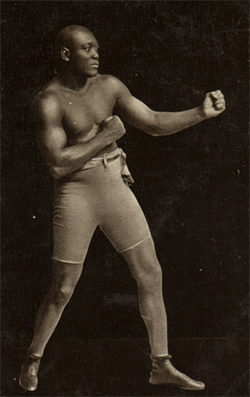
Jack Johnson
By: "BC" Bob Witt
|
|
|
Born: March 31 ,1878
Galveston , Texas
Died: June 10 , 1946
(91-14-12)
Hall of Fame Induction 1990 |
Whenever great Heavyweights are
discussed by knowledgeable boxing fans Jack
Johnson's name will surely be one of those names that all will agree
upon, the Galveston Giant was one of the best.
The fact that he was the first African-American Heavyweight Champion
would alone seal him a place in the sports history books. However there
is so much more to this mans life and ring career that set him apart
from the rest.
Johnson's bold and independent nature both enraged and endeared people
of his
day, color was the dividing line. The first quarter of the 20th century
was a
time in which our country was experiencing great growing pains, and
ideas like
racial equality were radical at least. Someone like Jack Johnson
becoming
wealthy, powerful, and famous was downright shocking. Johnson took it
all in
stride, he after-all, was something special and he knew it.
The son of a former slave, he grew up in
extreme poverty, with virtually no
schooling, and to say that blacks were second class citizens
would be an extreme
under-statement. Johnson went to work on Galveston's docks and
anywhere else
he could to eke out a living. He got his introduction to
fighting during this period, engaging in battle royals a
racially motivated sport where white audiences tossed coins to
the winner.
Records indicate Johnson fighting professionally as early as
1894 in Galveston.
Records of the time are un-reliable, however an account of
Johnson's early loss to west coast Champion Joe Choynski in 1901
remains a milestone in his career. Choynski KO' d Johnson in the
3rd round, police raided the fight and jailed them both. While
locked up, Choynski acted as mentor for Johnson, teaching him
ring tactics, which with his considerable talent, took hold very
rapidly. |
|
 |
In 1903, fighting on the west coast
Johnson defeated Denver Ed Martin to win the
black heavyweight title. Four successful defenses followed each with Sam
McVey.
In 1905 he lost a decision to future champ Marvin Hart. Two years later
Johnson
was back east in Philadelphia, there he would KO former Champion Bob
Fitzsimmons.
Johnson would then have to overcome being repeatedly denied a title shot
until
finally in 1908 he got the chance in Australia, to fight reigning
champion
Tommy Burns. Johnson scored a 14th round TKO to become the first of his
race to be Heavyweight Champion.
|
At the time, America was in general a
racially segregated society, and popular professional sports
was limited to baseball and boxing, so this event was big news
to the sporting public. Therefore, many whites were outraged. A
search for a White Hope was started. Middleweight great Stanley
Ketchel tried to unseat Johnson, however it proved to be a
fruitless attempt as Johnson toyed with Ketchel until the 12th
when Johnson was floored, the enraged Johnson then promptly KO'd
Ketchel with one mighty blow. |
|
|
Former heavyweight champion James J.
Jeffries was enticed to come out of
retirement and try to topple Johnson. A much ballyhooed bout was staged
in Reno, Nevada on Independence Day 1910. This was of course before
radio and
television, but when Johnson KO' d the former champ in the 15th, the
news
spread through the country like wildfire. Race rioting followed ,
several people
were killed in this rioting un-fortunately.
Jack Johnson's title reign would continue until 1915, during which time
he not
only taunted the white establishment by romancing a string of white
women, he
continued his winning ways with wins over boxers like Jim Flynn and
Frank Moran.
The Moran bout, a 20 round affair in Paris, refereed by Georges
Carpentier,
was captured by the movie camera and has been shown many times since. In
this
film , Johnson is shown as an extremely gifted athlete as well as a
superb ring
tactician.
Racism of the day resulted in legislation which caused Johnson to
become a
fugitive and flea the country. The moral excuse was that he had
transported a
minor across state lines for immoral purposes, it mattered not that the
woman in
this case was his wife.
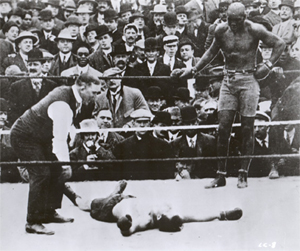
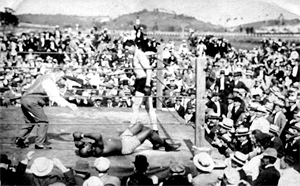
Finally in 1915, the now exiled Johnson ,was
lured to Havana, Cuba with the promise of safe return to his
homeland, which didn't materialize, for a bout with the huge
Kansan Jess Willard. The bout itself, which ended with Johnson
being stopped in the 26th round, is shrouded in controversy,
arguments still rage today as to whether Johnson took a dive or
not. The film and stills of
this dramatic bout are still viewed often today, and make
fascinating viewing. |
|
|
In 1920 Johnson surrendered to
Federal authorities, spent some months in Federal penitentiary and was
released. The aging Johnson continued his ring career with intermittent
bouts throughout North America, even returning to Havana, and fighting
in a bull ring in Mexico.
In retirement Jack Johnson raced cars, acted in movies, ran a night
club, and
died in an auto accident.
Many books and articles have been written about this larger than life
figure,
and of course sometimes the line where fact ends and fiction begins is
blurred.
His place in boxing history might be argued sometimes, but it surely
can't be
over looked.
Photos Courtesy of Antiquities
of the Prize Ring |
|
|