|
|
|||||||||||||||||||||
|
Will Pacquiao’s
Promise To Burn A Path Through Mexico End With De La Hoya?
Rightfully, Pacquiao’s certitude going into his first fight with Juan Manuel Marquez was justifiable after his monumental win over Barrera. His only vice seemed to be that he was largely a one-dimensional fighter. Marquez clearly had the stronger arsenal of boxing weapons. Raw power, impervious boxing ability and the skill to make adjustments during a fight are a few of his many strengths. Yet, for as complex a fighter as Marquez is, Pacquiao’s unrelenting aggression and incredible work rate kept the fight competitive and close. In fact, he managed to catch Marquez completely off guard with his style and knocked him down three times in the first round. Although their first match ended in a draw, Pacquiao’s stock continued to rise.
Despite losing to Erik Morales in his first outing as a super featherweight, Pacquiao quickly regained his dominant form by avenging his loss to Morales not once, but twice. Their second match ended in a ten round TKO victory. After challenging and beating the rugged Oscar Larios in July of 2006, he sought to prove that his win against Morales was no fluke. Thus, in November of 2006, Pacquiao thoroughly battered Morales for three rounds and won by knockout.
It was clear that Pacquiao was progressing as a fighter and becoming an insolent threat in the super featherweight division. Pacquiao’s current reign as the Pound-for-Pound King of Boxing can be attributed to the level of opposition he faced in the past five years. Many fighters, such as Felix Sturm and Julio Cesar Chavez Jr., elect to fight inferior opponents for the mere purpose of padding their records. On the other hand, Pacquiao chose the arduously clever path of facing fighters that not only posed a serious threat, but (more importantly) challenged his abilities to the extent that his travails in the ring resulted in enhancements to his fight game. After all, it was Martin Luther King Jr. who once said, “The ultimate measure of a person is not where they stand in moments of comfort and convenience, but where they stand in times of challenge and controversy.”
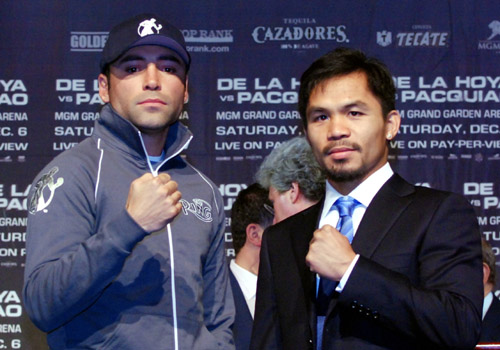
Challenges are obviously not foreign to Manny Pacquiao, but his latest endeavor appears highly unattainable and, quite frankly, masochistic. After capturing the WBC lightweight title with a superfluous ninth round TKO victory over David Diaz in his first fight at 135 lbs., Pacquiao chose to move up twelve pounds and fight Oscar De La Hoya at welterweight. The decision to fight De La Hoya was partly due to Freddie Roach’s coaxing of Pacquiao and his belief that the “Golden Boy” cannot pull the trigger.
Roach has been an exceptional trainer for Manny Pacquiao. He adequately prepares him for every bout through rigorously paced training sessions, using top-notch boxers as sparring partners and developing as well as teaching Pacquiao unique game plans that not only work best with his peculiar fighting style, but also work best to mitigate his opponent’s advantages.
Pacquiao is largely still a one-dimensional fighter, but he has gone through a subtle metamorphosis under the tutelage of Roach. His relentless pressure and power shots are his biggest weapons, yet during the second bout with Marquez and, most recently, his fight with David Diaz, Pacquiao has shown more poise. Instead of wildly swing punches to overwhelm his opponents, he relies more on his jab and side-to-side movement as a means of finding opportunities to unload his brazen, but calculated aggression.
Pacquiao has shown vast improvement to his fight game, but no fighter is without flaws. His tendency to abandon defense and overwhelm opponents by throwing a barrage of hard, fast and straight punches is a dangerous trait to have going into his fight with De La Hoya. In fact, Marquez’s superior boxing skills, ring generalship and counterpunching tactics seemed to fluster Pacquiao in both of their fights. Their second fight appeared closer and more than a handful of boxing fans, including myself, scored the fight for Marquez. In addition, 130 lbs. Marquez managed to badly wobble Pacquiao with a left hook in the second round of their second fight.
In case you are unaware of a widely known Oscar De La Hoya fact, his most dangerous weapon happens to be his left hook. It was used to defeat Fernando Vargas and Ricardo Mayorga, both whom were considerably heavier than Pacquiao at the time they fought De La Hoya. Vargas’ fractured eye socket was a true testament to the feral power De La Hoya’s left hook possesses. Hence, Pacquiao’s margin of error he is allowed to commit in this fight is rather slim as his ability to recover from a De La Hoya left hook.
Size and power are obviously going to be a huge advantage for De La Hoya going into the fight, but his stiff left jab will also be a major factor. De La Hoya is naturally left-handed, but he fights in a conventional stance. Therefore, he is more inclined to throw the jab with conviction rather than to merely distract his opponent because he’s throwing his jab off of his power hand. Unfortunately, Pacquiao leads in with his head while throwing his multi-punch combinations. De La Hoya’s left jab, which was highly effective against Floyd Mayweather Jr., who was considered to be one of the best defensive fighters on the planet, could easily prevent Pacquiao from applying the constant pressure he relies upon to wear down his opponents. Furthermore, De La Hoya’s effective left jab would provide him the opportunity to land 2, 3 or 4 punch combinations to the head and/or body as well creating momentary openings for that left hook upstairs.
Those hard left jabs and furious multi-punch combinations will leave Pacquiao reluctant to engage De La Hoya, which will allow Oscar the time and space needed to methodically breakdown Pacquiao to a mere shell of his invincible self. The weight difference may cause confusion and trick the casual boxing fan into believing that De La Hoya is far superior to Pacquiao, but the reality is that the damage Oscar’s power will inflict nullifies whatever advantages Manny will bring to the table.
Very few individuals have succeeded in jumping weight classes and scoring victories against notable opponents. Roy Jones Jr. and Floyd Mayweather Jr. are two recent fighters who have accomplished such a feat, but they offered more versatility to their fight strategy than Pacquiao. With that said, I find it surprising that a couple of highly-esteemed boxing dignitaries praised the fight between Oscar De La Hoya and Manny Pacquiao. They believe that the Philippine is doing what many fighters have done decades before.
Recent boxing history paints a different picture as to the competitive nature of such bouts. A few examples include: Roy Jones Jr. vs. Felix Trinidad, Oscar De La Hoya vs. Arturo Gatti, Bernard Hopkins vs. Oscar De La Hoya and Winky Wright vs. Ike Quartey. Clearly the most brutal of the aforementioned fights was the bout between Oscar De La Hoya and Arturo Gatti. De La Hoya went into the fight knowing Gatti could not hurt him, so he could be the blatant aggressor without suffering any repercussions.
One bout in particular, which illustrated the brutal effects of a weight disparity between combatants, was between Bob Foster and Dick Tiger. Dick Tiger was a career middleweight who challenged Bob Foster, arguably one of the best light heavyweights of all time, for the WBC and WBA light heavyweight title in 1968. Foster knocked Tiger out with a vicious left hook.
I was fortunate enough to meet Bob Foster a few weeks ago. He was graciously signing autographs in a mall in his hometown of Albuquerque, New Mexico. The first words out of my mouth were, “One of the greatest knockouts I have ever seen was that wicked left hook you unleashed on the chin of Dick Tiger!” He looked at me square in the eyes and said, “He was too small! He should have stayed at Middleweight. He bit of more than he can chew fighting me at light heavyweight!” Ironically, the banner that stood between me and the legend represented one of his futile attempts at becoming a successful contender in the heavyweight division. The banner contained a picture of Foster trading shots with Muhammad Ali. Foster, who was 40 lbs. lighter, was knocked out by Ali in the eighth round.
Only time will tell if history will repeat itself. De La Hoya is training with conviction I have not seen since he fought Ricardo Mayorga and we know what resulted in that fight. He is mad, focused and determined not only to beat Pacquiao, but to hurt him with a pugilistic fury that will match the anger he feels towards Roach’s personal verbal attacks and Pacquiao’s sudden rejection of a proposed promotional agreement between himself and Golden Boy Promotions.
Pacquiao may be naturally lighter than De La Hoya, but when he steps into the ring on December 6 he will be carrying the weight of the Philippines on his shoulders. Pacquiao is always hungry and will stop at nothing to win. The possibility of Oscar’s shoulder injury affecting his performance, his stamina issues and the uncertainty as to how he will be able to deal with Manny’s constant and unrelenting pressure for twelve rounds are all major factors that can make the impossible possible for the “Pac Man.”
Will Oscar De La Hoya pull the trigger and dethrone the Pound-for-Pound King? Will Pacquiao beat Oscar with his asserted aggression and remain the pound-for-pound best fighter in the world? We will find out when “The Dream Match” becomes a reality on December 6th! 
|
||||||||||||||||||||