| |
|
|
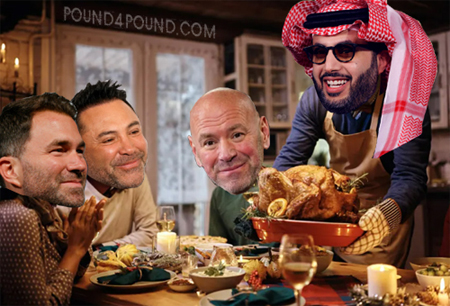
Pound4Pound.com's 2026 Turkey of the Year Award
One Man Brought The Feast. Now Everybody
Is Wondering Who's Picking Up The Check.
By William Trillo
With the holiday season upon us, it's time for
Pound4Pound.com's annual tradition of recognizing the
individual in boxing who has gone over and above — and
sometimes under and below — the call of duty during the past
year.
This Thanksgiving, however, we decided that one award simply
wasn't enough. So, along with our traditional Turkey of the
Year, we're introducing a second, considerably less coveted
honor.
We'll get to that one shortly.
The Turkey Of The Year:
Turki Alalshikh & The Saudi Boxing Experiment
Before proceeding, we want to acknowledge that Turki
Alalshikh has publicly discussed his health
difficulties. We sincerely wish him well and want to
make clear that this award is in no way intended to make
light of his personal circumstances. Our selection has
nothing to do with his health. It concerns his influence
on professional boxing, the financial environment
created during his involvement, and the consequences the
sport may now face.
When Turki Alalshikh entered the boxing landscape, he
didn't exactly tiptoe into the room. He arrived with a
checkbook that seemed to have no bottom and a
willingness to spend money on boxing events that the
sport had rarely, if ever, experienced.
Through Riyadh Season, Saudi Arabia became the
destination for some of the biggest fights in boxing.
The purses were extraordinary. Fighters throughout the
cards were reportedly receiving seven-figure paydays,
while the headliners were collecting sums that would
have seemed almost unimaginable under traditional boxing
economics.
Suddenly, the benchmark had changed.
For fighters, trainers, managers and promoters, Riyadh
had become the place to be. The money was flowing, the
paid-for invitations were plentiful, and there was no
shortage of people eager to celebrate this new era of
boxing.
Promoters, managers, trainers and sometimes even cutmen
were suddenly donning their traditional Saudi Shemaghs
and Ghutras, posting photographs of themselves across
every social media platform imaginable and making it
appear as though Alalshikh had suddenly become their
very best friend.
And why wouldn't they? When somebody else is picking up
the tab, it's a wonderful time to be in the boxing
business.
But there was always one rather inconvenient question
hanging over this lavish arrangement: How long could it
last?
Apparently, not forever.
Now, as questions mount about the future of Saudi
involvement and the level of financial commitment that
made this boxing boom possible, the sport is facing a
reality check. The seemingly bottomless well of money
appears to be getting considerably shallower, and the
people who became accustomed to those extraordinary
purses are discovering that the old financial rules may
once again apply.
The problem is that the bar has been set incredibly
high.
Once fighters become accustomed to receiving sums that
bear little resemblance to what a fight can
realistically generate, it becomes difficult to convince
them that the market has changed. A fighter who once
expected a multimillion-dollar payday doesn't
necessarily want to hear that the economics of the fight
no longer support it.
Take the Shakur Stevenson situation with Zuffa Boxing.
Stevenson was reportedly associated with a $15 million
payday expectation, a figure Bob Arum cited when
discussing the apparent reduction in Saudi financial
support. The precise contractual numbers have not been
publicly established, but the episode illustrates the
enormous expectations that had developed around these
arrangements.
And that's just one example.
Arum was already warning about the changing financial
landscape back in October, explaining that boxing would
continue, but that the market would eventually have to
settle around the money actually available.
It was a warning worth hearing. Yet, seemingly, very few
were listening. Or perhaps they simply preferred not to
hear it.
The question now is whether the sport is prepared for
what comes next.
For a few years, promoters, fighters and their
representatives enjoyed an extraordinary financial
environment. Some embraced it, some built their business
plans around it, and others appeared perfectly
comfortable assuming the good times would continue. They
were more than happy to accept the invitations and enjoy
the free ride to Riyadh.
But boxing has been here before. Money comes into the
sport, expectations rise, and eventually somebody has to
figure out how to pay for the party.
This time, the adjustment could be particularly painful
because the Saudi spending spree established
expectations that traditional boxing revenue may simply
be unable to support.
If Alalshikh's involvement diminishes substantially or
comes to an end following the December 11 Fury-Joshua
blockbuster, what exactly is he leaving behind?
Certainly, there will be some memorable fights and some
very wealthy fighters. There will also be promoters,
managers and trainers who enjoyed an extraordinary run.
But there is a much larger question about the long-term
health of the business.
Who replaces that money? Who funds the next generation
of major events? And how many fighters, accustomed to
the Saudi standard of compensation, will be willing to
accept what the actual market can afford?
The sport will survive. Bob Arum has said as much. If
anyone has seen this movie a time or two, it's Arum.
Take him at his word. Boxing has survived financial
booms, promotional wars, television changes and the
departure of major investors before.
But surviving and thriving are two different things.
For all the spectacular events, enormous purses and
grand promises about changing boxing forever, the Saudi
experiment has left the sport facing a financial
adjustment that could take some time to sort out.
And perhaps that's the biggest irony of the entire
operation. The man who helped make boxing's biggest
paydays possible may also be leaving behind a sport
struggling to figure out how to pay for them going
forward.
Let's face it. Turki came in, established a financial
standard that is virtually impossible for anyone else to
match, and now the sport is left scrambling to figure
out how to operate without that level of spending.
The people who enjoyed the feast may soon discover that
the leftovers aren't nearly as appealing.
No one seems particularly thankful for that.
For his contribution to the world of boxing in 2026, we
present Turki Alalshikh with Pound4Pound.com's TURKEY
OF THE YEAR AWARD.
We hope he enjoys the honor.
And, once again, we sincerely wish him well.
And Now For A Little Extra ...
Let's just say that when the fellow who helped supply
the feast starts tightening the purse strings, some of
the guests may discover that they were never quite as
financially independent as they thought.
And one particular boxing operation may be finding that
out the hard way.
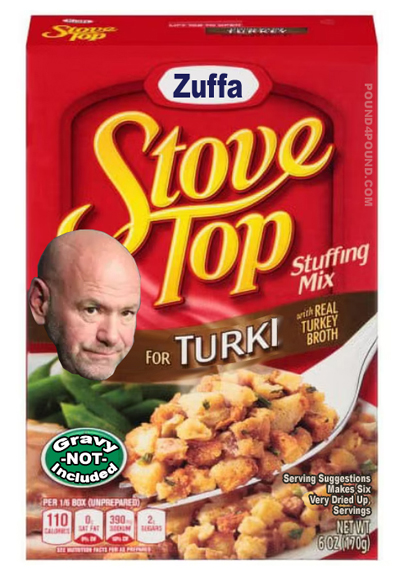
The No Gravy For The Stuffing Award:
Dana White & Zuffa Boxing
When Dana White announced his arrival in professional boxing
with Zuffa Boxing, he came armed with the usual promises of
revolution. Boxing was broken, the old guard had failed, and
he was going to show everybody how the business should be
run. Apparently, all that was needed was Dana White, a
checkbook and a little UFC magic.
There was certainly no shortage of ambition. Unfortunately,
the results have been considerably less impressive.
Zuffa assembled a stable that, to this point, has done
little to distinguish itself, staged a series of largely
forgettable promotions, and discovered that signing
recognizable fighters is considerably easier than making the
fights those fighters actually want.
Then came Shakur Stevenson.
After signing a multi-fight deal with Zuffa in July,
Stevenson was granted his release in October without ever
fighting under the company's banner. He had reportedly been
seeking a payday in the neighborhood of $15 million for a
major fight, a figure Bob Arum questioned as financially
unrealistic without the Saudi money that had helped fuel
Zuffa's ambitions.
Stevenson eventually moved on, saying he had spent eight
weeks preparing for fights that never materialized. So much
for taking over the boxing world.
And that brings us back to the fellow who was expected to
help finance this grand new boxing adventure.
Arum's October comments were particularly pointed. He
questioned whether Zuffa would be willing to spend its own
money to promote fights if the Saudi backing disappeared,
noting that the company had made commitments to shareholders
about how it would operate.
In other words, the other people's money problem hadn't gone
away. In fact, it had simply become harder to ignore.
Dana White arrived promising to change boxing. But changing
boxing requires more than press conferences, big
announcements and a collection of fighters with somewhat
impressive résumés. It requires making fights that people
want to see, at prices the business can actually afford.
And if the financial support that helped launch this
operation is no longer available at the same level, Zuffa
may discover that the boxing business doesn't operate quite
like the UFC.
For that little lesson in promotional economics, we're happy
to present Dana White and Zuffa Boxing with
Pound4Pound.com's No Gravy For The Stuffing Award.
Every free ride eventually comes to an end.
And this particular gravy train may have just hit the
desert.
|
|
|