The party isn’t over, so don’t turn out the lights. Not yet anyway.
On Saturday, October 31, Canelo Alvarez faces Christian Mbilli in Riyadh. The Saudi money is still there, and American fans are being asked to pay $79.99 to watch it on DAZN pay-per-view.
The concerns surrounding this event go beyond travel complications. On Thursday, Saudi authorities reported that air defenses intercepted two ballistic missiles launched toward Riyadh. An emergency alert was later lifted, and the fight remains scheduled for Saturday.
With fighters and their teams already dealing with travel difficulties, missing flights, alternate routes and undercard changes, the road to fight night has become a story of its own. Lindolfo Delgado’s title opportunity was among the bouts caught up in the travel chaos.
Saudi money has not disappeared. Far from it. The event is still happening. But it raises a reasonable question: Is staging major boxing events in a region facing missile attacks worth the risks and logistical complications for the fighters, their teams and everyone involved?
And how much longer can boxing count on this kind of money being available?
That question has been at the heart of this series.
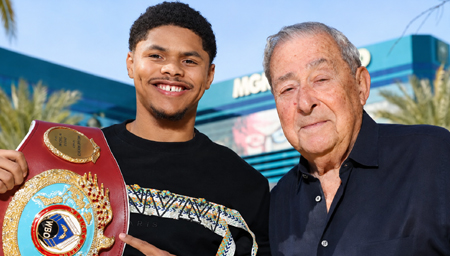
We began by examining Zuffa Boxing and the promise of a different business model. We looked at Shakur Stevenson and the difficult distinction between being a generational talent and being worth whatever number gets attached to your name. Then we turned to Bob Arum, a promoter who has lived through enough financial cycles to recognize that boxing’s money never stays in one place forever.
Now comes the uncomfortable part. What happens when everybody has to start doing the math?
The Money Is One Problem. The Price of the Product Is Another
Oscar De La Hoya recently announced a December 5 card headlined by David Benavidez against Michal Cieslak, with Vergil Ortiz Jr. facing Keith “Father Time” Thurman underneath.
Benavidez is a champion. Cieslak is a world champion, too, although he is hardly a household name to the casual American fan. Ortiz is an unbeaten star with plenty to prove. Thurman is a former champion whose best years are behind him and who is coming off a stoppage loss to Sebastian Fundora.
Those are the matchups.
Now comes the sales pitch: Pay-Per-View.
Why?
We just watched O’Shaquie Foster and Emanuel Navarrete meet in a three-belt unification fight on DAZN without an additional pay-per-view charge. Two world champions, three belts at stake, and a fight with real consequences and intrigue for the division.
Why should fans have to pay extra to watch one champion face an opponent many of them barely know, and another face a former, oft-injured champion trying to legitimize himself?
There are genuine sporting arguments for both December matchups. Cieslak is not a nobody simply because his name doesn’t sell tickets in every American market. Thurman still has a name and years and years and years of experience that must account for something. But the question isn’t whether these fights have merit. It’s whether the price being demanded matches the value being offered.
Promoters can complain about Zuffa, argue about its business model and question its intentions. They can debate the future of boxing until the next press conference or they are blue in the face, whichever comes first.
They still have to sell their own product.
Pointing fingers at Dana White is all well and good, but my advice is to worry about your own company and take care of your own business. That’s how the reboot will begin.
The Promoter Has to Earn the Price Tag
And speaking of Oscar, there is a little history worth remembering.
On April 25, 2024, when Turki Alalshikh selected Eddie Hearn to promote the Riyadh Season card at Los Angeles’ BMO Stadium, De La Hoya fired back with his famous declaration: “This is war!”
Oscar was defending his territory, or so he said. No promoter, he insisted, was going to come into his backyard and take over his sport.
Seven months later, in November 2024, Oscar sold The Ring to Turki for a reported $10 million.
Fast-forward to 2026, and Oscar says he regrets the sale. He has publicly attacked the magazine’s credibility and rankings, arguing that its reputation has been damaged.
That’s quite a journey from declaring war to selling one of boxing’s most historic institutions to the very man whose growing influence had prompted the declaration.
Oscar is entitled to his opinion, and his criticism doesn’t automatically settle the question of The Ring’s credibility. But it does illustrate the larger issue running through this series: money changes relationships, ownership changes, and the institutions fans once trusted can become part of the same commercial struggle as everybody else.
As a kid, I always looked forward to seeing my father walk through the door with the latest issue of The Ring that he picked up at the local newsstand, tucked under his arm. To me, it was indeed the “Bible of Boxing.” It was a connection to the sport, its history and the fighters who made it what it was.
Nat Fleischer died in 1972, and since then, the magazine has passed through several hands, with major ownership changes beginning in 1979. Over the decades, perhaps it was inevitable that some of what made The Ring special would get watered down.
I haven’t felt that same connection to The Ring in a very long time.
That’s not a personal shot at anyone currently involved with the magazine. It’s about what the publication represented to generations of boxing fans, myself included, and the feeling that something so important to the sport ought to stand on its own, independent of the interests of any promoter or financier.
The question is not whether boxing needs money. Of course it does.
The question is what the sport is building with it.
Because if all this money produces bigger purses but leaves fans paying more for questionable value, fighters struggling to reach events, and the sport’s institutions fighting over credibility, what exactly has been fixed?
Which brings me back to Bob Arum.
Arum has been down this road before. Beginning in 2013, Top Rank staged a series of major boxing events in Macau, including Manny Pacquiao’s fights against Brandon Rios and Chris Algieri, with backing from the Venetian. It was another ambitious venture built around international markets and casino money. Arum has been there, done that.
So, when Bob Arum has something to say about foreign investment, big money and the future of boxing, it’s probably worth putting down the phone, turning off the noise and paying attention. He’s not speaking from the sidelines. He’s speaking from experience.
This entire four-part series began with a four-minute video that crossed my feed. Arum was holding court with a group of media people. You could hear the laughter in the room. He was comfortable, surrounded by people who appeared to be enjoying the conversation.
There were nuggets in those four minutes worth examining. Arum was talking about the business, the money and what might happen when the financial landscape changes.
At one point, he offered a rather telling observation about boxing’s future:
“All I know is that the sport will continue, there will be great fights being made. How everybody will be compensated remains to be seen.”
I watched the clip and wondered how many people would actually stop to consider what he was saying.
The video was posted here and there on social media, got a few views, and then was most certainly replaced by the next four-minute video interview within the hour. No comments. No thoughts. Just post the interview and move on to the next one, ad infinitum.
Hardly journalism.
Outside of a couple of articles, I saw very little commentary examining Arum’s thoughts about the financial state of boxing.
Maybe I expected too much. But a veteran promoter talking about the future of the business deserved more than a clip, a laugh and a scroll to the next thing.
So, I started writing.
Over the past couple of years, my own enthusiasm for boxing has waned. Outside of covering some local shows, I found myself short on inspiration. I’d been around long enough to know that the sport could be maddening, and lately I wasn’t sure I had much interest in saying the same things all over again.
That four-minute clip changed something. It reminded me that there are still important questions to ask, still stories worth examining, and still a business worth challenging when the answers don’t add up.
Good news, fight fans:
I’m back.
For now.
If Arum is right and boxing is heading toward a financial reset, perhaps a full reboot is exactly what the sport needs. Maybe the next chapter will force promoters to rethink their expectations, fighters to reassess their options and worth, and the people financing the sport to decide what they actually want to accomplish.
Or maybe boxing will do what boxing has always done: find another pile of money, throw another press conference, and convince everybody that this time things will be different.
We’ll see.
If this reset produces better fights, more sensible business decisions and a sport that remembers the people paying to watch it, I may find myself writing more often again.
And if boxing gets back to being boxing — the rivalries, the characters, the controversy, the great fights and the occasional circus — you might just see me become that guy you loved to read.
Or the guy you loved to hate.
Either way, I’ll have something to say.
The money may change.
The promoters may change.
The business model may change.
But boxing will survive. Bob Arum knows that.
The question is who will be writing the checks, how much they’ll be worth, and who will be cashing them. And what will the sport look like when the dust settles?